
Circularity
Increasing circularity, while also reducing the volume of products and materials we use, can also deliver clear environmental benefits. Both these measures are important in reducing the upstream CO₂e footprint caused by ‘purchased products’, and the downstream footprint related to ‘end-of-life treatment of sold products’. We aim to maximise the use of renewable and recycled materials in our products and to promote the reuse and recycling of our products at the end of their life, thereby minimising waste.
We can achieve these goals through design, the choice of materials used in our products and recycling. Increasing our circular inflow (using different materials and products) means constantly finding new balances between greater circularity, affordability and quality. Progress also depends heavily on innovation and market developments.
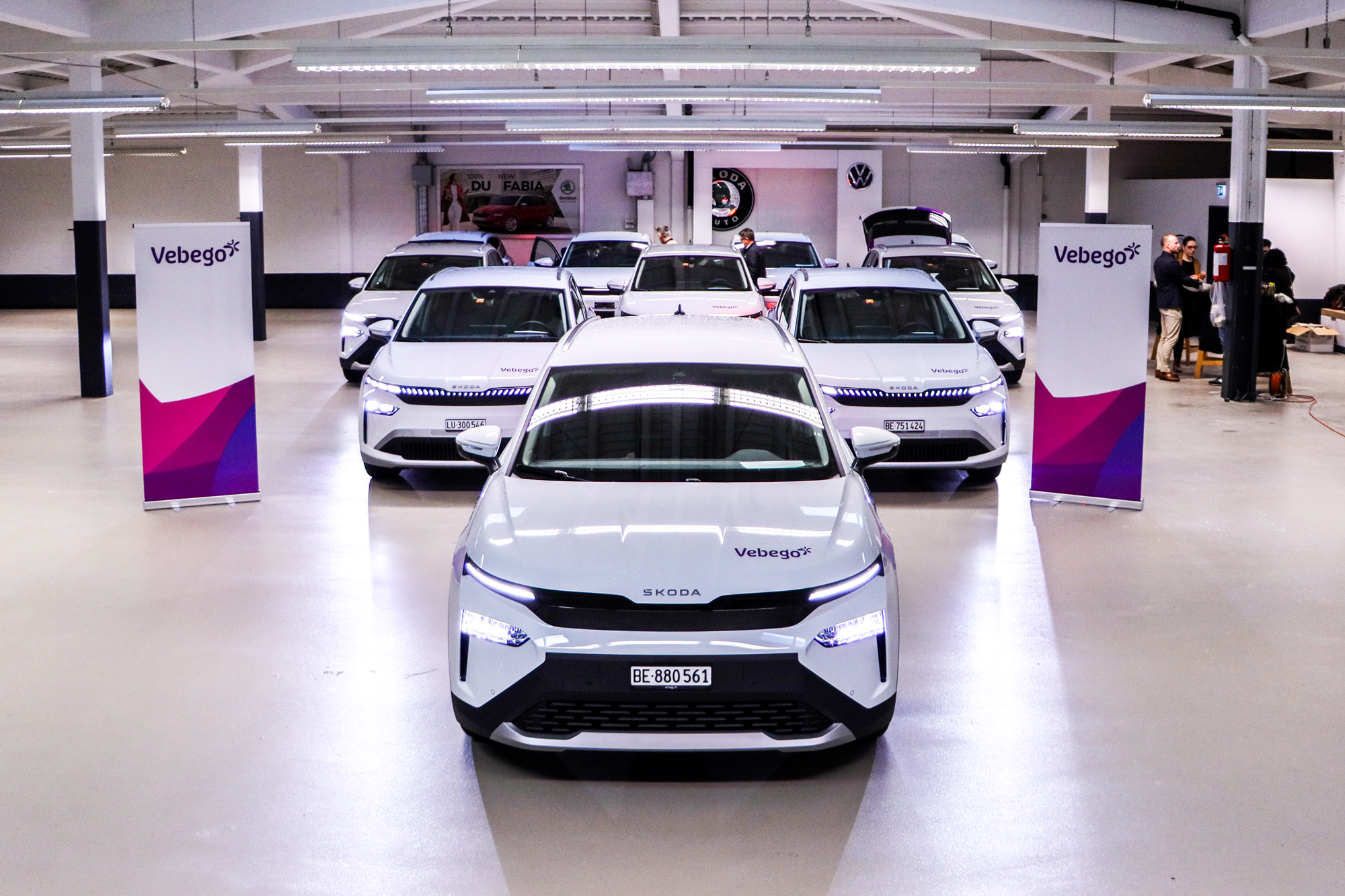
The electrification of our Vebego fleet is progressing rapidly and has already reached 52% (NL). The photo shows a delivery of 11 new Škoda cars to Vebego AG in November 2025.
Of course, we cannot cover our entire range of products. We therefore focus on those that account for the largest share of what we buy. Vebego Bright Solutions accounts for the largest percentage of product volume. Vebego companies that do not buy through Vebego Bright Solutions must also increase their circularity.
Circularity management occurs at the product level, with the DPP helping to give us a clear insight into the circularity of each product. Currently, only Vebego Bright Solutions is preparing DPPs for its cleaning products. The figures below, therefore, only refer to products sourced through Vebego Bright Solutions.
At the end of 2025, we had prepared a DPP for 261 products. Although this accounts for only 8% of Vebego Bright Solutions’ products by count, it represents 53% of the total volume by weight. The aim is to have prepared enough DPPs by 2030 to cover 75% of our volume by weight.
Circularity can be divided into ‘circular inflow’ (the materials used in the products we purchase) and ‘circular outflow’ (the products we use in our business or sell to external parties).
For inflow, our target is to achieve at least 50% circularity by 2030. This will involve achieving a 70% circular inflow across 75% of the total weight. In 2025, we achieved a 24% circular inflow overall, reflecting a circular inflow of 46% for 53% of the total weight. This was the same as the year before. To reach our target, we need to accelerate the preparation of DPPs, roadmaps and execution.
As products are also sourced outside Vebego Bright Solutions, and there are no DPPs for these products, the actual circular inflow in 2025 will have been lower than the 24%.
We have developed a circularity dashboard for reporting purposes. This shows the circularity of any combination of company, product and customer.
EcoVadis
EcoVadis is an evidence-based online platform for rating supplier sustainability that we use to assess the ESG performance of specific suppliers. The results are presented in a scorecard overview of a supplier’s strengths and areas for improvement.
As we require some of our suppliers to use the EcoVadis methodology, we also use it to rate our own companies when it is useful (i.e. when the rating supports commercial processes). We can be proud of our achievements in 2025. Vebego Facility Solutions in the Netherlands achieved an EcoVadis Bronze award, while Vebego AG and Vebego Facility Services in Germany secured Gold. This was the second year in a row that Vebego AG achieved EcoVadis Gold. We also scored seven points more than last year, an improvement of 10%. This places us in the top 5% of all companies worldwide assessed by EcoVadis, and in the top 1% worldwide for environmental performance. This award confirms our daily commitment to environmental protection, labour and human rights, safety, ethics and sustainable procurement.